
The Answer Is the Least Interesting Part
Why, in the age of instant AI answers, the working matters more than ever.
·The Matheculator team·5 min read
For most of history, getting the answer to a maths problem was the hard part. You needed the method, the time and the patience to grind through it. The answer was the prize.
That is no longer true. Type a quadratic, a loan scenario or a statistics question into almost any AI tool and a confident answer appears in a second or two. The answer has become cheap.
So what is valuable now? We think it is the part that used to get skipped: the working.
A cheap answer is not the same as a useful one
An answer on its own tells you very little. It cannot tell you whether the units matched, which rule was applied, or where a sign quietly flipped. It cannot tell you whether the question you typed was the question you meant.
When the stakes are a homework exercise, that is an inconvenience. When the stakes are a mortgage comparison, a dosage conversion or an engineering tolerance, it is a real risk. A wrong number that arrives with confidence is more dangerous than no number at all, because it feels finished.
The working is what turns a number into something you can check, trust and act on.
What the research is starting to show
One of the clearest studies so far comes from a randomised trial with nearly 1,000 high school maths students in Turkey, published in PNAS in 2025 by Hamsa Bastani and colleagues.
Students were split into three groups for practice sessions. One used textbooks and notes. One used a standard ChatGPT-style assistant. One used the same model with teacher-designed guardrails: it gave hints step by step and would not simply hand over the answer.
During practice, both AI groups did far better than the textbook group. The standard assistant lifted practice scores by 48%. The guided tutor lifted them by 127%.
Then the AI was taken away for an exam. Students who had practised with the standard assistant scored 17% lower than students who never had AI at all. Students who had used the guided tutor scored the same as the control group. The harm had been largely removed by one design choice: show the steps, don't skip to the end.
The most striking finding was about confidence. Students who leaned on the unrestricted assistant felt they had learned as much as everyone else. They had not. The tool had done the thinking, and the students could not tell.
Three people who need the working
We build Matheculator for three kinds of people, and each of them needs the working for a different reason.
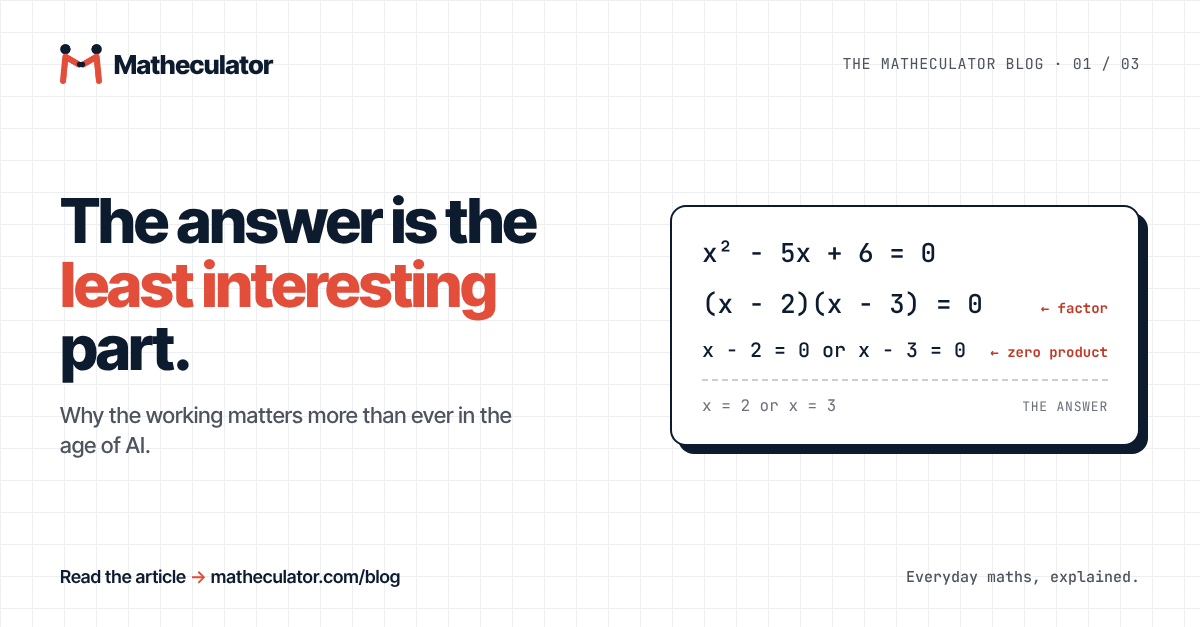
The learner needs it to recognise a method. Seeing that x² − 5x + 6 = 0 factors into (x − 2)(x − 3) = 0, and that the zero-product rule gives x = 2 or x = 3, is how the next problem becomes solvable without help.
The professional needs it to inspect assumptions. A loan figure is only as good as the rate, term and compounding behind it. A conversion is only as good as its units. Visible steps let an expert spot the one input that doesn't fit their case.
Everyone else needs it to catch mistakes before acting on them. You don't need to remember the formula for compound interest. You do need to see that the calculation used annual compounding when your account compounds monthly.
Verifiability is a design decision
It is easy to build a tool that hands out answers. It is harder to build one that makes those answers checkable. That takes deliberate choices:
- Show every step, with the rule behind it. Not a summary of the method; the method itself.
- Publish the formula. A dedicated calculator should state exactly what it computes, so its assumptions can be inspected.
- Make a second check easy. A solver and a calculator that reach the same result by different routes are worth more than either alone.
- Be honest about limits. AI can make mistakes. Saying so plainly is part of being useful, not a weakness.
These principles sit at the centre of our Honor Code: verifiable answers, visible steps and independent judgement for anything consequential.
The new skill is checking
As answers get cheaper, the skill that grows in value is the ability to look at a result and ask whether it makes sense. Is the magnitude plausible? Do the units cancel? What happens if one input changes?
That skill is built by following the working, again and again, until it becomes instinct. A tool that hides the working takes that practice away. A tool that shows it hands the practice back.
The answer still matters. It is just no longer the interesting part. The interesting part is everything that tells you whether to believe it.
Try it with your next problem: the Matheculator AI Solver shows every step and the rule behind it.
Sources
- Bastani, H. et al. (2025). Generative AI without guardrails can harm learning: Evidence from high school mathematics. PNAS 122(26).