
Numeracy Is a Decision Skill, Not a School Subject
The most expensive maths mistakes are made long after the last exam.
·The Matheculator team·5 min read
Ask most adults when they last "did maths" and they'll name a classroom. Ask when they last compared two mortgage offers, judged a discount, worked out a medication dose for a child or checked whether a pay rise beat inflation, and the answer is probably this month.
We file maths under education. In practice, it is one of the main tools adults use to make decisions. And the evidence suggests that tool is getting blunter.
What the adult skills data shows
In December 2024, the OECD published results from its Survey of Adult Skills, which tested around 160,000 adults aged 16 to 65 across 31 countries. Twenty-seven of those countries also took part a decade earlier, so the trend is visible.
It isn't encouraging. Average numeracy improved in only eight countries; in most, it stagnated or declined. The lowest-performing tenth of adults lost ground in most countries. In a later brief, the OECD estimated that around one in three adults lack the literacy or numeracy needed to take full part in a modern economy.
The financial picture echoes this. Economists Annamaria Lusardi and Olivia Mitchell designed three simple questions on interest, inflation and risk diversification as a standard test of financial literacy. In Lusardi's 2021 analysis of US respondents, only 29% answered all three correctly.
These aren't questions about calculus. They are questions about everyday money.
Where numeracy shows up in real life
The cost of weak numeracy rarely looks like a wrong answer on a page. It looks like a decision that seemed reasonable at the time.
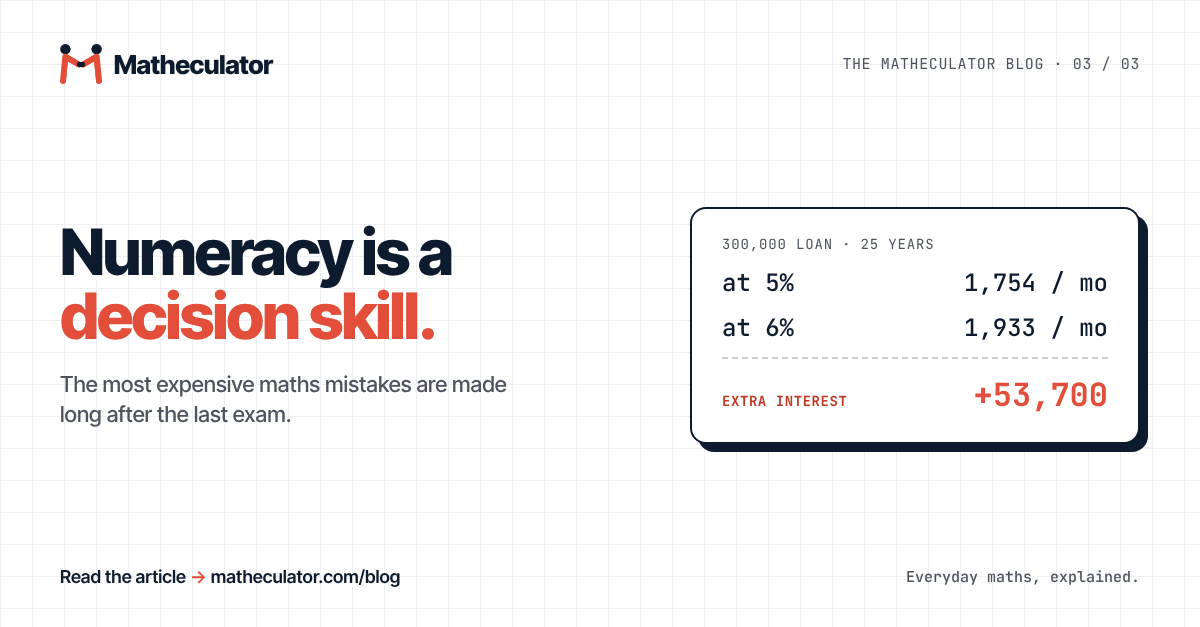
One percentage point on a mortgage. On a 300,000 loan over 25 years, moving from 5% to 6% raises the monthly payment from about 1,754 to about 1,933. That's 179 a month, and roughly 53,700 more interest over the life of the loan.
The quiet power of compounding. 10,000 left for 25 years at 5% grows to about 33,864 with annual compounding. At 5% simple interest it reaches 22,500. Same rate, same years, more than 11,000 apart.
Percentages that hide their base. A 50% rise followed by a 50% fall doesn't return you to where you started; it leaves you 25% down. Headlines, offers and statistics lean on this kind of confusion all the time.
None of these needs advanced maths. Each needs the habit of asking: what exactly is being calculated, and what happens if one number changes?
Why this is a design problem, not just an education problem
It is tempting to say adults should simply learn more maths. Some will. But most people make financial and health decisions under time pressure, with the formula long forgotten.
That is where tools matter. A good tool for adults does three things:
- Starts from the question, not the formula. You know you want to compare two loans. You shouldn't need to remember the amortisation formula first.
- Makes scenarios cheap. The insight usually comes from changing one input. What if the rate is 1% higher? What if I pay for 20 years instead of 25? Seeing the difference is what builds intuition.
- Shows its working. A result you can inspect is one you can question, and one you can explain to a partner, a client or yourself next year.
This is why Matheculator publishes the formula behind every dedicated calculator and lets you rerun scenarios in seconds. The goal isn't to make you dependent on a calculator. It's to make the maths in your decisions visible, so your judgement can do its job.
A different definition of being good at maths
For adults, being good at maths has little to do with mental arithmetic speed. It means knowing which question to ask, recognising when a number looks wrong, and understanding which input drives the outcome.
Those are learnable habits, and they compound like interest. Every time you check a scenario instead of guessing, you get slightly better at the next decision.
Numeracy isn't something you finish at school. It is something you use, or lose, every week.
Run your own numbers: compare scenarios with the Mortgage Calculator or see compounding at work in the Compound Interest Calculator. Calculators give estimates, not personalised financial advice.