
We've Been Here Before
What fifty years of calculator research tells us about AI in maths.
·The Matheculator team·4 min read
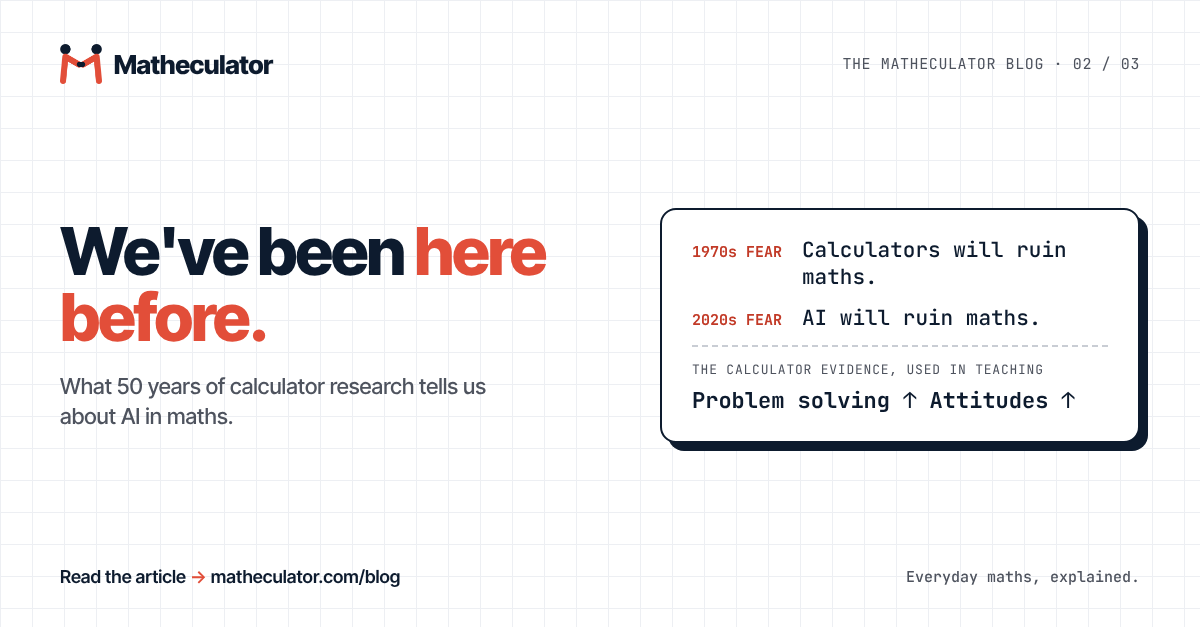
In the 1970s, a cheap electronic calculator arrived in classrooms and a familiar fear arrived with it. If a machine can do the arithmetic, will children ever learn to do it themselves? Will a generation forget how to think?
Half a century later, the same question is being asked about AI, only louder. The good news is that we don't have to guess. The calculator debate produced decades of research, and its lessons transfer remarkably well.
What the calculator studies found
Two large reviews pulled that research together.
In 1986, Ray Hembree and Donald Dessart analysed more than 70 studies of calculators in school maths. Their overall finding surprised many critics. In most grades, students who used calculators alongside regular instruction did as well or better in problem solving than those who did not. The one consistent exception was young children's hand computation, where some groups without calculators did slightly better.
In 2003, Aimee Ellington reviewed 54 more studies published between 1983 and 2002. When calculators were built into teaching, students' operational skills and problem-solving skills improved. Students who used them also reported more positive attitudes towards maths.
Neither review said "hand out calculators and walk away". The benefits showed up when the tool was part of how maths was taught: used to explore, to check, to take on harder problems. The skill of computing by hand still needed its own deliberate practice.
Same question, sharper edge
AI is not just a faster calculator, and it would be naive to pretend otherwise. A calculator does exactly what you tell it. An AI tool will interpret your question, choose a method and explain its reasoning, all on your behalf. That makes it far more powerful as a teacher, and far more tempting as a shortcut.
The early evidence mirrors the calculator story with higher stakes. In a 2025 randomised trial of nearly 1,000 high school students, published in PNAS, students who practised with an unrestricted chatbot scored 17% lower on a later exam taken without it. Students who used a version designed to give step-by-step hints instead of answers did as well as the control group, while performing far better during practice.
The pattern is the one the calculator researchers saw: outcomes depend less on the tool than on how it is designed and used.
Four lessons that carry over
1. Integrate, don't substitute. Calculators helped when they were woven into teaching and hurt when they replaced it. An AI solver should extend a student's reach to harder problems, not stand in for the first attempt.
2. Protect the core skills on purpose. Hand computation needed dedicated practice even when calculators were everywhere. Today's equivalent is reasoning through a problem unaided. Timed practice without help, like a quiz with hints that unlock one step at a time, keeps that muscle working.
3. Explanation is the guardrail. The AI tutor that did no harm in the 2025 study was the one that showed steps rather than answers. Visible working turns a shortcut into a lesson.
4. Attitude matters. Ellington found calculator users liked maths more. Tools that reduce friction and fear can draw people into maths rather than away from it. That is worth protecting, not dismissing.
The real question
The calculator didn't make us worse at maths. It changed which parts of maths were worth spending time on, freeing attention for setting up problems, judging results and asking better questions.
AI can do the same, on a much larger scale, if we build it with the lessons we already paid for. The question isn't whether people should use AI for maths. They already do. The question is whether the tools they use are designed to teach or designed to finish.
We know which one we're building.
Practise without the safety net: try a timed Matheculator quiz with step-by-step hints, or skim a study guide before your next test.
Sources
- Hembree, R. & Dessart, D. (1986). Effects of hand-held calculators in precollege mathematics education: A meta-analysis. Journal for Research in Mathematics Education 17(2).
- Ellington, A. (2003). A meta-analysis of the effects of calculators on students' achievement and attitude levels in precollege mathematics classes. Journal for Research in Mathematics Education 34(5).
- Bastani, H. et al. (2025). Generative AI without guardrails can harm learning. PNAS 122(26).